
Discover all the key components of a complete IBC tank, from metal cage mesh and base structure to plastic inner tank, valve, lid, and protective accessories.

An Intermediate Bulk Container (IBC) is not a single product, but a carefully engineered system composed of multiple structural and functional components.
Each part plays a critical role in strength, safety, durability, and transport performance.
Below is a detailed, step-by-step explanation of all main components that form a complete IBC tank, following the actual manufacturing and assembly process used in modern IBC production lines.
The production of an IBC cage starts with a welded metal wire mesh panel, manufactured on an automatic cage welding line.
Provides external mechanical protection
Ensures stacking strength
Maintains container shape during transport and storage
Precisely welded steel wires
Uniform mesh spacing
High welding consistency to avoid weak points
This metal mesh panel is the structural backbone of the IBC cage.

Once the mesh panel is completed, it is automatically bent into a square cage shape.
The flat mesh is bent at precise angles
The head and tail ends are aligned and connected
Dimensional accuracy is strictly controlled
Accurate bending ensures:
Perfect fit with the plastic inner tank
Stable load distribution
Uniform appearance across all IBC units

After cage forming, the lower part of the cage goes through a punching and flattening process using a punching & flattening machine.
Remove specific bottom sections of the wire
Create flat, connection-ready surfaces
Prepare the cage for base assembly
This process allows the cage to be securely connected to:
Steel base pallets
Plastic base pallets
Wooden pallets (in some regions)
Without this step, stable base fixation would not be possible.

The base (pallet) is a critical load-bearing component of the IBC tank.
Steel pallet: Highest strength and durability
Plastic pallet: Lightweight and corrosion-resistant
Wooden pallet: Cost-effective for specific markets
Supports full liquid load (up to 1000 liters)
Enables forklift handling
Ensures safe stacking and transport

The formed metal cage is mechanically fixed to the base using bolts and screws.
Strong and reliable connection
Easy maintenance or replacement
Compatible with different base types
This step finalizes the rigid outer structure of the IBC.

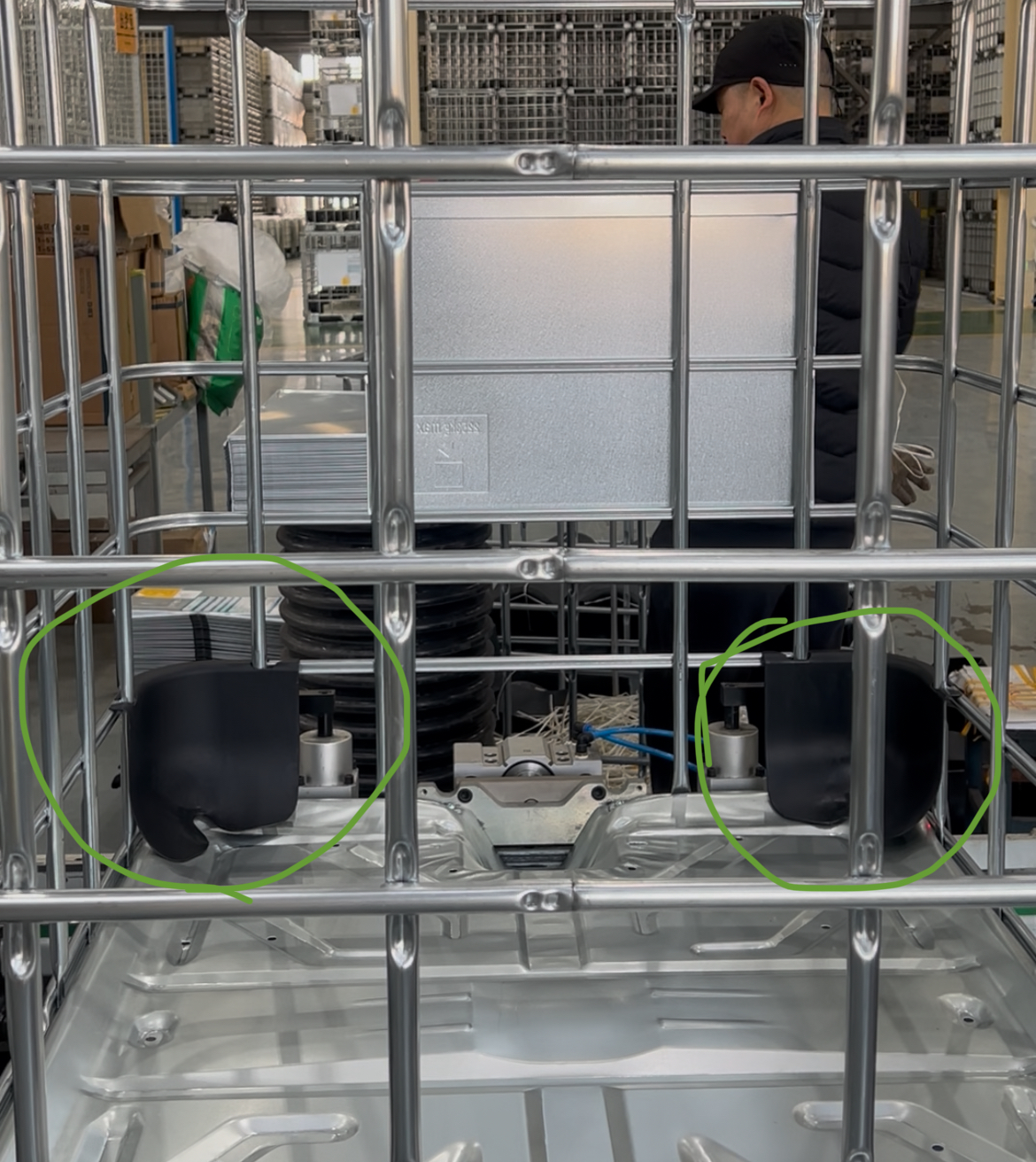
To prevent direct contact between the plastic tank and metal cage, plastic corner protectors are installed.
Reduces friction during transport
Prevents abrasion and wear
Extends the service life of the inner tank
Improves overall safety
These small components play a big role in long-term durability.
A complete IBC tank is finished with essential functional components:
Installed at the bottom of the inner tank
Controls liquid discharge
Available in different materials and standards
Seals the filling opening
Prevents contamination and leakage
Improves liquid stability
Reduces movement during transport
Enhances safety for liquid handling


A fully assembled IBC tank includes:
Welded metal wire mesh panel
Bent and formed metal cage
Punching & flattening preparation
Steel / plastic / wooden base pallet
Bolted cage-to-base connection
HDPE plastic inner tank
Corner protectors
Valve, lid, and baffle
Each component must be precisely manufactured and perfectly integrated to ensure product quality, safety, and compliance with international standards.
Ningbo Xinzhou Welding Equipment Co., Ltd. provides complete IBC production line solutions, including:
IBC cage welding production lines
Cage bending, punching, and flattening systems
Steel pallet welding lines
IBC blow molding machines
Raw material supply (wire, tubes, pallets)
Valves, lids, corner protectors, and accessories
Turnkey IBC factory solutions
From individual machines to full production lines, we help customers build stable, efficient, and scalable IBC manufacturing systems.
 English
 Pусский
 Français
 Español
 Português
 العربية

